Tuesday, December 22, 2009

Weekly Vocab Builder

This week's list is a hodgepodge of words not often used. Try one out!


You can also get Vocab Builder daily, Monday through Friday, through my Twitter posts. Follow @ebrenner to get it!

This is my last post until 2010. Have a great holiday, everyone!

Friday, December 18, 2009

Making Fewer Mistakes, Not Less

Why do we say:
We have less money to buy fewer groceries.
Instead of:
We have less money to buy less groceries.
Or:
We have fewer money to buy less groceries.
Because grammar, the mechanics of language, matters. Said Melissa Biro in a recent LinkedIn discussion on less and fewer: "Does grammar matter? Do the nuts and bolts in your car's engine matter? Only if you want the car to run smoothly/only if you want communication to flow." We want our writing to communicate our messages, our meaning. We want to take the ideas in our heads and transfer them to our readers. And when the mechanics of language are wrong or seem off, our writing doesn't go smoothly and something gets lost in the translation to our readers. I don't know about you, but that second example sentence gave me pause and that last one made me cringe.

The Difference Between Less and Fewer

To begin with, Merriam-Webster's Collegiate Dictionary defines less as "constituting a more limited number or amount." It defines fewer as "a smaller number of persons or things." The definitions themselves point to the terms' different usage. Less refers to a mass of something (mass noun), whereas fewer refers to something we can count (countable noun). Less is generally used for mass nouns (less sand, less meaning), while fewer is used for countable nouns (fewer books, fewer children). Said another way, less is for singular nouns (less pride, less flour) and fewer is for plural nouns (fewer emotions, fewer flowers).

Except

You knew there would be a wrinkle, right? It wouldn't be English without one. Less, or more properly less than, can also be used for time, amounts, or distances:
  • She has less than three weeks to complete her manuscript.
  • I've saved less than $1,000 this year.
  • The children walked less than two miles to the store.
In these cases, although a specific amount of time, money, or distance is given, the meaning is for some unspecified amount less than that specified.

And of course, language is changing all the time. Bryan A. Garner notes in the latest edition of Garner's Modern American Usage that less is appearing more frequently in places where fewer once did. Garner offers this example: "You will have less [read fewer] people to call and haunt about paying for their outfits and buying their accessories." "Advice for the Bride," Boston Herald (Mag.), 19 Oct. 1997, at 6. (507)

My own reaction, and perhaps yours as well, to my initial example sentences bear this out, too. Less groceries doesn't offend me quite as badly as fewer money. And let's not forget the classic example:

Garner cites the "12 items or less" lane as a big part of less overtaking fewer in some cases. According to Garner's Language-Change Index, this error is at stage 3: "commonplace even among many well-educated people but is still avoided in careful usage."

Recap

  • Less is used for mass nouns, such as music and education.
  • Fewer is used for count nouns, such as lyrics and classes.
  • Less is also used for time, amounts, and distances: 12 hours, $3, 10 miles.
  • Be aware that less is being used more often for fewer (12 items or less); while it is widespread, the careful writer should avoid it.
Have questions on less vs. fewer or another grammar point? Drop me a line or leave it in the comments below.

Wednesday, December 16, 2009

Please Ignore

Trying to claim my blog on Technorati. Please ignore this post.

9PTDPB9JN7GP

Tuesday, December 15, 2009

Weekly Vocab Builder

Some uncommon words to enliven your writing:
  • Sojourner: a visitor; a traveler who stays somewhere for a short time
  • Aha moment:  epiphany; a moment of intellectual discovery
  • Punctilious: meticulous; taking note of small details
  • Forfend: to forbid; also to protect
  • Incarnadine: blood-red; also to make such a color
You can also get Vocab Builder daily, Monday through Friday, through my Twitter posts. Follow @ebrenner to get them!

Friday, December 11, 2009

Dash It All

Hyphens, and Em-dashes, and En-dashes, Oh My!

Hyphens and dashes are common pieces of punctuations that can really improve your writing—if you know how to use them. Hyphens can show relationship between words and numbers. Em-dashes can lend your writing a bit of excitement. And en-dashes can show a range in an elegant manner. Today, a brief rundown of what they are and how to use them.

The Hyphen (-)

It's just a little horizontal line, but the hyphen is a handy piece of punctuation. Among its many uses:
  • To join two words in a compound word, such as a phrasal adjective:  brand-new blogger
  • To join two names in a compound name: Robert Smith-Jones
  • To show word divisions: tan-ta-lize
  • To separate characters: 555-123-4567
  • In e-mail addresses and URLs
Note, however, that adverbs that end in -ly are not hyphenated in an adjective phrase as a rule: lovingly made mittens. I notice this a lot from writers who use AP Style, and it drives me crazy. Did AP once say to use a hyphen with a phrasal adjective containing an -ly adverb? (Honestly, I don't know. If you do, tell me!) And because I've said this is the rule, I'm sure someone will come up with an exception to it. If so, please leave it in the comments below.

Did you notice another use of the hyphen? It can be used to show prefixes and suffixes, as in -ly.

The Em-Dash (—)

The em-dash is so called because it is the width of the capital m in the same font. Often on the Web (and back in the day, on a typewriter), it is represented by two hyphens (--), though you can use one of the ASCII codes: ampersand-pound-8212-semi-colon or ampersand-mdash-semi-colon. Some style guides put a space before and after it (e.g., AP Style); some don't have a space on either side of it (e.g., Chicago). Either way, the em-dash's most common use is to set off a part of the sentence, usually with strong emphasis. You could also use a comma, a colon, or parentheses to set off the text, but be sure to match the punctuation's strength with your words' emphasis.

Don't forget if you set off a word or phrase in the middle of the sentence, you need a matching set of punctuation marks. That is, if you introduce a phrase with an em-dash, you must also end the phrase with an em-dash. Same applies if you go with a less-emphatic punctuation mark.

Grammar Girl has a helpful post on em-dashes versus colons. This has stayed with me:
A dash also introduces extra material, but, well, a dash is quite a dramatic punctuation mark. A dashing young man is certainly not an ordinary young man, and if you're dashing off to the store, you're not just going to the store, you're going in a flurry.

The En-Dash (–)

The en-dash is half the width of an em-dash (ASCII codes: ampersand-pound-8211-semi-colon and ampersand-ndash-semi-colon). I see fewer and fewer en-dashes in everyday copy; it seems to be relegated to very formal writing only. Which is too bad, because the en-dash is a useful little piece of punctuation:
  • It can represent the word to in a range: 2001–2009. Used this way, both ends of the ranges are included, which is a fine point often ignored these days. And with the en-dash, you don't need the from to precede your range: The Christmas sale, running SaturdayMonday, will offer great savings.
  • It can join a phrasal adjective when part of phrase is an open compound: New Mexicobased.
  • It can represent a range with no ending: 2001.

Further Reading

These resources offer deeper discussions into hyphens and dashes, as well as explain a couple other, rarer dashes (so rare that I've never used them).

Tuesday, December 8, 2009

Weekly Vocab Builder

This week's list of words is a short one, but I think they're worth your effort:
  • Skullduggery: deception, fraud, subterfuge.
  • Jack-up: a drilling rig used offshore; also an increase, as in price
  • Eviscerate: to disembowel; to take away a vital part.
  • Cri de coeur: literally, a cry of the heart (French); an impassioned cry, usually of protest.

A Request

A friend asked me to highlight Spanish words in the Vocab Builder. What foreign words, Spanish or otherwise, do you use to give your writing a dash of exotic or worldliness? E-mail me, and I'll highlight them in a future blog post.

And don't forget to follow me on Twitter to get the Vocab Builder every weekday!

Friday, December 4, 2009

Are You a Grammar Ninja?

Sometimes one grammar quiz just isn't enough. OK, maybe if you're a grammar geek like me, one isn't enough, but it's probably more than enough for the rest of the world. Still, sometimes you need to brush up on your grammar skills. Herewith, then, some quiz sites, a widget and a podcast, and one very addictive game.

Quizzes

  • UsingEnglish.com. UsingEnglish offers many grammar tests and will keep track of the tests you've taken and your scores, a very useful function. Although you have to register to use the site, registration is quick and free.
  • Capital Community College's Interactive Quizzes. If you don't want to register with a site, check out CCC's quizzes. The site's loaded with them, and you can skip the registration process.
  • Internet TESL Journal's Self-Study English Grammar Quizzes. Internet TESL Journal's done us the favor of ranking its quizzes as easy, medium, or difficult. The downside is that you aren't inputting your answers anywhere. Do the quizzes in your head or on a piece of paper, then click on the answer drop-down menus to find out the correct answer.
  • Purdue OWL's Exercise Pages. The plus here is that you get a lesson before you do the quiz. On the OWL site, click on a topic in the left nav bar, such as "Appositives," and read the brief lesson. When you're ready, in the left nav click on the exercise, like "Apppositives Exercise." Again, you'll need to do the quiz in your head or on paper. Click "Go to answers" when you're ready to grade yourself.
  • Dave's ESL Cafe. The grammar and the writing exercises offered at Dave's ESL Cafe may be a bit easy for a native English speaker, but they're still good practice. And the site will score your quizzes for you.
  • EnglishClub.com's grammar and vocab quizzes. EnglishClub also categorizes the difficulty level of its quizzes. At least a couple quizzes I took fed me one question at a time. Do yourself a favor and click the link to see all the questions at once. You'll save yourself a lot of clicking.

A Widget and a Podcast

Grammar Girl, which is a great podcast you can subscribe to, has a widget for your site. I've added it to this blog and it's been on my iGoogle page forever. The quiz itself doesn't change very often, but you can share your love of grammar with your own readers on your site. Try it out!

The Game

Finally, a little bit of fun (warning: it's addictive!): Grammar Ninja. Begin by choosing your level: Beginner Ninja, Skilled Ninja, or Master Ninja. You can even create your own sentences for Grammar Ninja: download the Grammar Ninja Sentence Creator and follow the directions in the ReadMe PDF.

What are your favorite quiz or lesson sites? Share them in the comments section below!

Tuesday, December 1, 2009

Weekly Vocab Builder

One of the things I love about words is how they can sometimes take on a personality that mirrors their definitions. I found this poem in one of my son's poetry books recently that exemplifies this idea:
Jittery seems a nervous word;
snuggle curls up around itself.
Some words fit their meanings so well:
Abrupt. Airy. And my favorite--

sesquipedalian,
which means: having lots of syllables.
--"Word Watch," Linda Sue Park
Here are some words to give life to your writing this week. Which do you think sound like their definitions?
  • Solidarity: unified.
  • Unfriend: New Oxford American Dictionary's Word of the Year means to remove someone from a social media network.
  • Black Sunday: April 14, 1935, on which the worst of the dust storms took place in the Dust Bowl. For more on the Dust Bowl, check out this American Experience episode.
  • Green trade war: what will occur if the US adopts carbon caps.
  • Frowzy: unkempt.
  • Soporific: sleepy.
And here's a bonus word. That poem above is a sijo poem: a Korean form of poetry not too different from haiku. In English, the sijo generally has three lines with 14 to 16 syllables each; sometimes the poem is broken into six lines. The last line offers a twist, some unexpected ending. If you want to know more, check out these sites: And the book the poem came from is lovely. Use this link to order it for young poetry lovers in your life (my own is enamored with it): Tap Dancing on the Roof: Sijo (Poems).

Friday, November 20, 2009

A Writer's Checklist

You've nurtured an idea, slaved over every word, and you're ready to send your words out into the world. But wait! Have you reread your work? Unfortunately, many small, easily fixed errors can creep into your copy (I'm always finding errors in my blog posts despite the time I spend bleeding over them). Take just a few minutes to review your copy, with this handy checklist in mind, and you'll increase the quality of your work:
  • Watch for missing words. You know what you want to say, but for some reason your fingers didn't type all the words. Especially if your copy isn't going to an editor next, reread your copy slowly. Read it out loud. Read it backwards. Read it in a different setting. Whatever it takes to make it seem new.
  • Check for homonym errors. Spell-checkers won't catch these bad boys. Homonyms are words that sound the same but are spelled differently and have different meanings. "To," "too," and "two" are a common set of homonyms that are often misused.
  • Companies are not people. Companies and organizations are referred to in the third-person singular: it and its.
  • Choose the right relative pronoun. Who refers to people; that refers to things.
  • Double-check words that are frequently confused. Be aware of such words as than/then and lose/loose. Weber State University offers a good list of frequently confused words. Print it up and tape it to your desk.
  • Check your math. If you include numbers and equations in your writing, double-check your math. There's nothing worse than misplacing a decimal point or transposing two numbers...except having your readers find that you did it.
Today's world moves fast. We're forced to write more and faster. That's when most errors sneak through. Taking just a couple minutes to review your copy helps ensure that it is of the highest quality, encouraging your readers to trust you and take your words, your message, seriously. And if you run short on time, drop me a line. Getting a professional editor gives your writing a better chance to meet its goals.

Tuesday, November 17, 2009

Weekly Vocab Builder

Could your writing use some oomph? Try using one of these words this week:
And did you hear? The New Oxford American Dictionary has announced its Word of the Year: unfriend. Says Christine Lindberg, senior lexicographer for the dictionary:
It has both currency and potential longevity. In the online social networking context, its meaning is understood, so its adoption as a modern verb form makes this an interesting choice for Word of the Year. Most un- prefixed words are adjectives (unacceptable, unpleasant), and there are certainly some familiar un- verbs (uncap, unpack), but unfriend is different from the norm. It assumes a verb sense of friend that is really not used (at least not since maybe the 17th century!). Unfriend has real lex-appeal.
Check out this year's runners-up as well at OUP's site (hashtag appeared earlier on one of my Wordnik lists). And follow me on Twitter to get the vocabulary word of the day. Maybe one of the words I cover will be next year's Word of the Year!

Thursday, November 12, 2009

That Which Has a Tail, Part 2: Quiz Answers

Did you try the exercise in yesterday's That Which Has a Tail post? Here are the correct answers:
  1. The letter that came today was nice than the one that came yesterday.
  2. Usually my mail, which is delivered at noon, is nothing but bills.
  3. A letter that is full of compliments is a joy to receive.
How did you do? Comment below with your thoughts!

Wednesday, November 11, 2009

That Which Has a Tail

Someone recently asked me the difference between that and which. I stumbled through a response, knowing I wasn't doing an adequate job of it. Herewith, a (hopefully) better answer. By the way, if you speak the Queen's English, the answer is short and sweet: there is no difference. But if you speak American English, read on.

That is a relative pronoun used for restrictive clauses, clauses that are necessary to the meaning of the sentence. If you didn't have the clause, the sentence would mean something different. The clause restricts the meaning. For example:
I picked up the books that were on the table.
The books I picked up are limited to the ones on the table; I didn't pick up the ones on the floor or on the shelf.

Which is a relative pronoun used for nonrestrictive clauses, clauses that add detail to the sentence but are not crucial to the sentence's meaning. If the clause were taken out, the sentence would still make sense. The sentence's meaning is not restricted. For example:
I picked up the books, which were on the table.
When I picked up the books, they were all on the table; there weren't any on the floor or the shelf. That they were on the table is extra information.

Note the comma before which. If you've got a nonrestrictive clause, you need that comma and the which. They tell the reader some extra information is coming up. You can remember that the witch (which) has a tail (,):

Bryan Garner gives three guidelines for deciding if you need that or which (Garner's Modern American Usage, 806):
  1. "If you cannot omit the clause without changing the basic meaning, the clause is restrictive; use that without a comma."
  2. "If you can omit the clause without changing the basic meaning, the clause is nonrestrictive; use a comma plus which."
  3. "If you ever find yourself using a which that doesn't follow a comma (or a preposition), it probably needs to be a that."
If it's still not clear, check out Grammar Girl's recent episode on that vs. which.

Back? OK, let's see if you've got it. In the following sentences from Grammar Smart by the staff of The Princeton Review (30), choose the correct pronoun:
  1. The letter (that, which) came today was nice than the one (that, which) came yesterday.
  2. Usually my mail, (that, which) is delivered at noon, is nothing but bills.
  3. A letter (that, which) is full of compliments is a joy to receive.
Update: Answers are posted here.

Friday, November 6, 2009

Weekly Vocab Builder

Improve your writing by increasing your vocabulary. This week's list:
  • Nurturance: going beyond nurturing, the nourishment and emotional and physical care of someone.
  • Acrostic: a poem in which the first letter of the first word in every line spells out a word when taken together. For example:
    Elizabeth it is in vain you say
    "Love not" — thou sayest it in so sweet a way:
    In vain those words from thee or L.E.L.
    Zantippe's talents had enforced so well:
    Ah! if that language from thy heart arise,
    Breath it less gently forth — and veil thine eyes.
    Endymion, recollect, when Luna tried
    To cure his love — was cured of all beside —
    His follie — pride — and passion — for he died.
                                               —"An Acrostic" by Edgar Allan Poe
  • Decision engine: Microsoft's marketing term for search engine.
  • Favicon: the small icon in a browser's address bar particular to a site.
  • More weight: Giles Corey utter these words during the Salem Witch Trials.
Follow me on Twitter to get the Vocab Builder every morning. (And thanks to City Dictionary for choosing more weight as yesterday's word of the day.)

Tuesday, November 3, 2009

Who vs. Whom and Other Writing Bugaboos

Every writer has them: little points of grammar she can never remember. Is it who or whom? When is effect the right word? Is it i.e. or e.g., and what do they stand for anyway? Herewith, a few points to help you produce cleaner copy.
  • Who vs. whom. Who is used in place of a subject noun, whereas whom is used in place of an object noun. Try switching out who/whom for he/him. If you'd use he, you want who; if you'd use him, whom is your answer:

    Who was late for dinner? He was late for dinner.
    I sent an e-mail to whom? I sent an e-mail to him.
  •  I.e. and e.g. I.e. stands for id est in Latin, which translates to that is in English. E.g. stands for exempli gratia in Latin, which is for example in English. If you can remember that i.e. is that is, you'll be able to make the right choice. (Anyone have a mnemomic device for remembering which is which?)
  • Affect and effect. Affect is generally used as a verb, and effect is generally used as a noun. Here's a mnemonic device, courtesy of Copyediting: "To Affect is to Act on, but the Effect is the rEsult."
  •  Farther vs. further. Farther is used for distances, while further is used for time or degree:

    I walked farther today than I did yesterday.
    John wants to discuss the topic further at the meeting.
What bugaboos haunt your writing? Let me know in the comments below and I'll cover them in a future post.

Friday, October 30, 2009

Unraveling the Mysteries of the Editorial Process

I recently read "Your Copy Sucks: You Don't Even Know What 'Edit' Means" by T.J. Dietderich on PR Breakfast Club. It was great to see someone not only defend editing but try to explain the different jobs that can come under the editing banner. I fear, though, that the post didn't go far enough to correct misconceptions about the editing process.

Titles vs. Tasks

Part of the problem is that an editor’s title may bear no relation to her role. As fellow editor Levi Bookin points out:
Doctors and nurses both work in the field of health. There are some functions that either might perform, such as injections, but each must have a certificate relating to the individual vocation.

Editors, copy editors, and proofreaders all work in the field of preparing a manuscript for publication, but none has to provide a certificate relating to his occupation. Any may do all the work of any or all of the others.
The role does not have to match the title in publishing. What does Senior Editor mean, anyhow? It doesn’t even give a hint as to what kind of editing that person might do. It could just as easily be a video editor’s title as a text editor’s.

Another part of the problem could be the type of publisher we’re talking about. Publishing has never been limited to just books and periodicals. Advertising, research papers, company reports: they’re all published works, just not all public works. All need writers and all need some sort of editing process to prepare the document for readers. They just don’t necessarily have the same process, nor do they need to.

But these days, publishing isn’t even limited to print. If you have a blog and regularly post to it, you are a publisher (and a writer and an editor and…). The digital world offers us cheap, even free, tools to get our ideas out there for all to see. As a result, not every publisher understands traditional publishing processes and what all those roles involved.

And let’s not forget that digital publishing is challenging traditional publishers, who are responding by compressing processes and cutting corners.

A Rose Is a Rose

An editor’s title notwithstanding, what does an “editor” do?
Let's start at the top. Dietderich talks about an "editor-editor" who assigns story ideas, decides what goes into the publication, and makes big changes to a piece, like the plot structure or the overall argument. This is a developmental editor. She might called an executive editor, an editor in chief, a senior editor, an assigning editor, or even a plain old editor. The developmental editor might give a writer an assignment, particularly if the publication is a periodical. She's got an idea or an outline for an article and she assigns a writer to it. When the writer turns in his assignment, the developmental editor may want big changes, such as structure or argument, so the article better fits her original idea or the purpose for the assignment.

In book publishing, the publisher might assign a developmental editor to a project. Maybe this is the writer's second or third book in a series and he's having trouble deciding how the story should grow, what order the action should be in, or something similar. The developmental editor helps him work out those issues.

Perhaps the writer is someone with an incredible story to tell, but he's not really a writer and needs someone to help him out. He may get a deal with a publisher who assigns him an editor. Or he may hire someone to help him with the writing process to get his story ready to shop around to publishers.

Once the writing is finished--the writer has told his story, feels the structure and argument are good, and is basically ready to hand over his labor of love to a publisher--it's time to polish the piece. There will be an editor to look at the document on the whole and section by section, another editor to look at it at the sentence level, and still another to look at it letter by letter. Not all publishers or media take such care with copy, and not everyone is aware of all these levels.

If your copy is fortunate enough to be in a process that takes such care, your copy will go to a substantive, or line, editor next. Again, titles abound and usually have nothing to do with job function: senior editor, editor, associate editor, and so on. However they are labeled, substantive editors look at the organization of the whole piece, structure, transitions (between chapters, sections, paragraphs, etc.), redundancies, jargon, sexist language, awkward constructions, excessive use of passive voice, wordiness, logic, tone, and so on. Substantive editors do not choose what goes into a publication.

The copy editor takes on the document next. She's looking at sentence order and structure, sentence and paragraph length (particularly if the piece is to be published online), grammar, word usage, punctuation, spelling, style, and anything else she's been asked to watch out for.

If the editorial process doesn't include a separate fact-checking phase, the copy editor must fact-check as well. The list varies but generally includes names, addresses, phone numbers, URLs, dates, other numbers, and basic facts (e.g., President Obama is the 44th president of the US). Plenty of print publishers still hire copy editors, though this is an area hit hard by economic downturns and the digital revolution. When you need to cut back on something, you tend to skimp on the quality. And copy editors ensure quality.

Proofreaders are the end of the line, and they make sure the finished project is correct. Exactly how they do that depends on the type of proofreading they do. Traditional proofreading compares "dead copy" against "live copy," that is they compare the last approved version of the piece against the new version and ensure they match and all changes have been incorporated. Editorial proofreading skips the dead copy part. The proofreader must read--and correct--("cold-read") the latest version (hopefully the version that will actually publish but not always) of a document. She corrects spelling, grammar, punctuation, and style.

If the Shoe Fits

As in Dietderich’s post, these are simplified definitions. Really, we're talking about two different things here: tasks and titles. I've seen plenty of companies advertise for a "proofreader"--and offer a proofreader's salary--for a copy editor's job. I saw one ad the other day that wanted the right person to be both copy editor and proofreader and still get the job done perfectly. Yet any good editor knows the best rule is "the more eyes, the better."

It's easy to miss an error in a piece you've read two or three times already. Your brain knows what comes next and your eye will skim the sentence, allowing your brain to remember rather than see. Only, your brain remembered what it was supposed to see rather than what it actually saw. Memory is funny that way. And the longer the list of possible errors is, the more opportunities to miss something.

I've also seen plenty of jobs that want the copy editor to be a writer as well. Again, these are two different skills sets. Not that you can't do both, but you shouldn’t do both on the same piece. And of course, they're paying copy editor wages, not writer wages, which are higher. Employers can slap any title they please on a job. Hey, I was ClickZ's Copy Chief & Associate Editor, yet I had no copy editors under me and I still can't tell you what "associate editor" was supposed to mean for my employer because other associate editors in the company did not do the same job I did.

In the end, the key isn't the job title; it's the tasks to be performed. When clients hire me to edit for them, I don't get hung up on titles (though I do define them on my site). Instead, I talk to them about what kind of things they want fixed. Spelling and punctuation? Check. Grammar? Check. Usage and style? Check. How about paragraph structure, transitions, awkward constructions, etc.? The list goes on until we’ve defined the job.

Every publisher's and writer's needs are different. It makes sense to know what the different levels of editing are, what the editor can do to help the copy, and what the editor's skill set is. Then, no matter what the role is called, you know what to expect from your editor. True, the jargon can weigh you down (you’ll keep reading this blog to learn more, right?). Also true, the editorial process will likely keep getting compressed (if so, I want to be called Super Editor)and even change as digital publishing continues to develop. Knowing what your editor's role is, rather than her title, will help you know what to expect from her.

Just don't ask what a subeditor is.

Postscript

A reader responded to this blog post elsewhere, adding these editing roles:
  • Acquisitions editor: This position is usually found within publishing houses. The editor will seek out books to publish and edit them into something usable.
  • Anonymous reviewer: Found in academic circles, this person reviews a manuscript from a technical perspective. She will suggest improvements to the author.
What other editing roles do you know of?

Tuesday, October 27, 2009

Weekly Vocab Builder

Missed one of last week's vocabulary words on Twitter? Here they are again:
  • Levelize: to even out; to make level. (Honestly, just use level.)
  • Sweet spot: colloquially, the coming together of just the right events or criteria.
  • Sea change: a massive change.
  • Metanoia: a change of one's core spiritualism.
  • Peep culture: a culture of posting one's life online and following others' lives online.
Try to use one in a sentence and leave it in the comments!

Thursday, October 22, 2009

Style Watch: Is It E-Mail or Email?

More than once during my tenure at ClickZ, I was asked to review style preferences on digital terms, most recently e-mail, Web, Internet, and home page.

These terms are new enough that their spellings are in flux. Should e-mail have a hyphen? If you have more than one e-mail, do you have e-mails? Should we cap Web and Internet? What about related terms, like Webmaster and Web page? And is home page one word or two? (If you're paying attention, you can figure out most of my style decisions from this paragraph.)

The key here is that, for now at least, these terms have more than one acceptable spelling. One hopes (at least I do) that these terms will settle down into one spelling, making writers' and editors' lives easier. Maybe it'll even happen in my lifetime. But I'm not holding my breath; dictionaries still list both catalog and catalogue.

So how does one go about deciding on a specific spelling? Do you follow the dictionary? And which dictionary is that anyway? Dictionaries don't always agree on things, even on a preferred spelling or if one spelling is truly preferred over another (more on dictionaries and how they work another time). What does your style guide or usage manual say? How about following what others in your industry do? Or following mainstream media, if that's more appropriate? Any of these resources might be the way to go (you do have these resources, right? If not, see my post on writers' resources.) ClickZ had a set style based on the Chicago Manual of Style and  The American Heritage Dictionary. But neither of these were industry-specific. There are many marketing organizations and they don't necessarily agree on style -- if they even notice it.

What's a style maven to do?

In the end, I decided to get the 50,000 feet view and make a decision based on that. I approached all the terms the same way, so let me outline just one: e-mail. Important to note: when I look at whether e-mail was used as a mass noun ("I receive so much e-mail!") or a countable noun ("I receive so many e-mails!"), I mostly ignored the hyphen question.

Dictionaries

I started with the dictionaries. Our house dictionary (the one we defer to most often) was The American Heritage Dictionary, 4th edition, and I weighted its opinion more. Here's what I found:
American Heritage Dictionary (4th ed., 2000): e-mail, e-mail (pl)
Merriam-Webster's Collegiate Dictionary (11th ed., 2003): e-mail, e-mail (pl)
Cambridge Dictionary of American English (2007): e-mail, e-mail (pl.)
Oxford American Dictionary (2005): email, emails
Webopedia: e-mail, also email; e-mail (pl)
Marketing Terms.com: email or e-mail; email (pl)
Free Online Dictionary of Computing: e-mail

Says the FODC, "The form 'email' is also common, but is less suggestive of the correct pronunciation and derivation than 'e-mail'. The word is used as a noun for the concept ('Isn't e-mail great?', 'Are you on e-mail?'), a collection of (unread) messages ('I spent all night reading my e-mail'), and as a verb meaning 'to send (something in) an e-mail message' ('I'll e-mail you (my report)'). The use of 'an e-mail' as a count noun for an e-mail message, and plural 'e-mails', is now (2000) also well established despite the fact that 'mail' is definitely a mass noun.

Style Guides and Usage Manuals

Next, I checked various style guides and usage manuals. Again, I gave preference to our house style guide, The Chicago Manual of Style, 15th edition. But no one guide aligns perfectly with every publication, so I felt the need to check out some others:
Chicago Manual of Style (15th ed., 2003): e-mail, e-mails
From CMS's FAQ page: "A. 'E-mail' and 'mail' aren’t exactly parallel in usage. We don’t say 'I received six mail today.' We say 'letters' or 'pieces of mail.' Since 'e-mail messages' is a few syllables longer than we generally tolerate in computerspeak, the coinage of 'e-mails' seems to perform a useful function. As for language going downhill, we prefer to believe that it is constantly evolving to meet our needs. (Otherwise, we would have to be grumpy all the time.)"
Wired Magazine: email, emails
Garner's Modern American Usage (2nd ed., 2003): e-mail, e-mails
Associated Press Stylebook (2009): e-mail, e-mails
From AP's "Ask the Editor" section: "A. We're holding the line on those spellings. E-mail is the first choice of Webster's [AP's house dictionary] and preferred by many newspapers. E-mail is consistent with other hyphenated, electronic age terms such as e-book, e-commerce, e-shopping and e-business."

Industry Organizations

So far, e-mail was in the lead, preferred not just by our house style guide and dictionary, but also by other word authorities -- all of which have language professionals behind them. What about industry professionals? What do those who may not give a dash for proper language, those whose goal is to sell something to someone, think? Rarely did I come across an organization that preached one form over another (the Email Experience Council being the notable exception; it's quite vocal about its style and I took it under strong advisement). I surfed around these organizations' sites to see what they practiced. Unfortunately, these organizations weren't always consistent. (Hey, if any of you professional organizations out there would like someone to make your site and your copy consistent, you know where to find me.) Here's what I found:
Organization
E-mail vs. email
Mass vs. Countable
Email Experience Council
email
emails
Direct Marketing Association
inconsistent, but email more popular
emails
American Association of Advertising Agencies
inconsistent, but e-mail more popular
inconsistent, but e-mail used more as a mass noun
Association of National Advertisers
inconsistent, but email more popular
inconsistent, but e-mail used more as a mass noun
Search Engine Marketing Professional Organization
inconsistent, but e-mail more popular
inconsistent, but emails more popular
Word Of Mouth Marketing Association
inconsistent, but email more popular
inconsistent, but emails more popular
Interactive Advertising Bureau
inconsistent, but email more popular
inconsistent, but e-mail used more as a mass noun
While the professional organizations were inconsistent (and often had unedited copy), email won over e-mail and email as a countable noun took the lead. Still, they were inconsistent (except the EEC) and copy didn't appear to be edited. Whenever I saw e-mail, was that an intentional decision? Did anyone even notice?

Search Engine Results

Finally, I checked search engine results. I checked news results (mostly edited content), general results (mostly unedited content), and blog results (again, mostly unedited content). I admit, I gave more weight to edited content, as someone gave some thought to spelling and style. I also had to compare emails against e-mails, as I couldn't think of how to tell when email or e-mail was used in the plural other than to read everything, and that just didn't seem practical.

Term
Google
Google News
BlogPulse
Google Blog Search
e-mail
1.6 billion
5.6 million
557,709
22.5 million
email
2.7 billion
2.5 million
1.3 million
239.1 million
emails
49.9 million
554,000
91,725
423,556
e-mails
97.4 million
213,000
251,381
9.6 million
I found the results interesting. In unedited copy, email was the hands-down winner, though e-mails trumped emails in the plural department. In edited news copy, e-mail and emails were more common. Even editors are inconsistent, I guess.

Conclusion

In the end, I went with e-mail and e-mails. More authorities and edited copy preferred them (sorry, EEC). I suspect, however, that one of these days language mavens will have to capitulate to language speakers who don't give a darn about "proper spelling" and allow email and emails to reign.

As I said earlier, I used much the same method for the other terms. I went with Web and capitalizing it in all its varied forms; Internet; and home page for much the same reasons I went with e-mail and e-mails. My choices may not work for you. Heck, they may not work for ClickZ's new style maven. They are a matter of style (at least for now), and style can be subjective. But if you have to choose one form over another, this system may be the way to decide on your style. Or you could just follow your style manual. Or your dictionary. Or your.... You get the idea.

If you'd like more information on why I chose the spellings I did with the other terms or on my method in general, drop me a line or leave a comment below.

Monday, October 19, 2009

Weekly Vocab Builder

I slacked a little last week on my vocabulary words, but I hope their unusualness makes up for it. Here's what you might have missed:
  • titivate: to make something neater or more beautiful.
  • rakish: fashionable. Also, disreputable.
  • petrichor: the smell of rain on dry ground.
If you're hungry for more words, check out some of my favorite resources:
And, of course, if you follow me on Twitter, you'll get a Vocab Builder every weekday.

Monday, October 12, 2009

Weekly Vocab Builder

Improve your vocabulary, improve your writing. This week's list:

  • Halcyon: a mythical figure. Also, calm, peaceful. Also, well see the link. This word has a lot of meanings.
  • Choral: a worship song.
  • Sesquipedalian: a long word. Also, someone who likes to use long words. And more. Click the link.
  • Raffish: stylish; being fashionable. It makes me think of its synonym rakish, which additionally means being disreputable, wanton.
  • Syllabication: breaking down a word into syllables.

Friday, October 9, 2009

Writing Tip: Five Resources Every Writer Needs

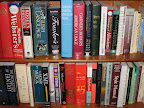
A small section of my reference library.

Dictionary

Dictionaries go beyond telling you how to spell word correctly and what a word means. They also give you word history, syllabication (a fifty-cent word for how it breaks into syllables), labels (offensive, slang, obsolete), and more. Here are some popular dictionaries:
  • Merriam-Webster Unabridged: A good unabridged dictionary will list far more words than a collegiate dictionary will. MW's dictionaries tend to be more conservative, meaning its lexicographers want more evidence of a word's stability before they add it to their dictionaries. You can subscribe to MWU online for a modest fee.
  • American Heritage Dictionary: By far my favorite dictionary. AHD tends to add newer words at a quicker rate and it offers excellent usage notes. The notes tend to be descriptive, meaning they describe the issue and differing opinions but don't dictate a solution. You can look up entries in AHD for free on Yahoo, get the dictionary on CD (beware: I had to give up my CD version when I switched to the 64-bit version of Vista; though I give Houghton Mifflin credit: when I reported to them I could no longer use the CD, they sent me an updated version for free. It will work for the 32-bit version of Vista, just not my less-popular 64-bit), or buy the paper version.
  • Webster's New World College Dictionary: The Associated Press's official dictionary. If you strictly follow AP style, this is the dictionary for you.
  • Word Spy and World Wide Words: These sites are good for very new terms. The men behind the scenes are serious about words and go to great lengths to define them.


Also check out industry-specific dictionaries and glossaries. Online, look for ones that have been edited by professionals. Webopedia is good for Internet-related terms. There's an editorial staff behind it that ensures definitions are accurate. (Disclosure: I used to work for Webopedia's parent corporation, though I never worked with the Webopedia folks.)

Thesaurus

Sometimes you just need a synonym -- or an antonym. A good thesaurus can help you out. Here are three I use:
  • Thesaurus.com: A free resource.
  • Visual Thesaurus: A neat concept, where you can see the relationship between words as distance. You can subscribe online or purchase the CD. (Again, my CD wouldn't work with my 64-bit Vista.)
  • Roget's International Thesaurus: The granddaddy of thesauri (or thesauruses, if you prefer Anglicized plurals). This is the one your English teacher probably taught you to use. She was right: the current version has more than 330,000 words and phrases.
  • The Gregg Reference Manual: The is a great reference for business style and offers a healthy section on grammar.

Style Guide

A style is meant to provide some consistency among a publisher's content. It should be invisible rather than distracting. Which style guide you follow depends on what you're writing about and who you are writing for.

Usage/Grammar Guide

You'll need at least one good guide on usage and/or grammar for when you run into sticky situations. Some are written in easy-to-understand English, others take a more comprehensive approach. Choose one that fits your style:

Writing Advice

What are your favorite resources? What else do you, as a writer, need? Let me know in the comments below!

(And, yes, I earn a few pennies if you use click on an Amazon link and buy a book. Support your local editor and click!)