Tuesday, November 3, 2009

Who vs. Whom and Other Writing Bugaboos

Every writer has them: little points of grammar she can never remember. Is it who or whom? When is effect the right word? Is it i.e. or e.g., and what do they stand for anyway? Herewith, a few points to help you produce cleaner copy.
  • Who vs. whom. Who is used in place of a subject noun, whereas whom is used in place of an object noun. Try switching out who/whom for he/him. If you'd use he, you want who; if you'd use him, whom is your answer:

    Who was late for dinner? He was late for dinner.
    I sent an e-mail to whom? I sent an e-mail to him.
  •  I.e. and e.g. I.e. stands for id est in Latin, which translates to that is in English. E.g. stands for exempli gratia in Latin, which is for example in English. If you can remember that i.e. is that is, you'll be able to make the right choice. (Anyone have a mnemomic device for remembering which is which?)
  • Affect and effect. Affect is generally used as a verb, and effect is generally used as a noun. Here's a mnemonic device, courtesy of Copyediting: "To Affect is to Act on, but the Effect is the rEsult."
  •  Farther vs. further. Farther is used for distances, while further is used for time or degree:

    I walked farther today than I did yesterday.
    John wants to discuss the topic further at the meeting.
What bugaboos haunt your writing? Let me know in the comments below and I'll cover them in a future post.

Friday, October 30, 2009

Unraveling the Mysteries of the Editorial Process

I recently read "Your Copy Sucks: You Don't Even Know What 'Edit' Means" by T.J. Dietderich on PR Breakfast Club. It was great to see someone not only defend editing but try to explain the different jobs that can come under the editing banner. I fear, though, that the post didn't go far enough to correct misconceptions about the editing process.

Titles vs. Tasks

Part of the problem is that an editor’s title may bear no relation to her role. As fellow editor Levi Bookin points out:
Doctors and nurses both work in the field of health. There are some functions that either might perform, such as injections, but each must have a certificate relating to the individual vocation.

Editors, copy editors, and proofreaders all work in the field of preparing a manuscript for publication, but none has to provide a certificate relating to his occupation. Any may do all the work of any or all of the others.
The role does not have to match the title in publishing. What does Senior Editor mean, anyhow? It doesn’t even give a hint as to what kind of editing that person might do. It could just as easily be a video editor’s title as a text editor’s.

Another part of the problem could be the type of publisher we’re talking about. Publishing has never been limited to just books and periodicals. Advertising, research papers, company reports: they’re all published works, just not all public works. All need writers and all need some sort of editing process to prepare the document for readers. They just don’t necessarily have the same process, nor do they need to.

But these days, publishing isn’t even limited to print. If you have a blog and regularly post to it, you are a publisher (and a writer and an editor and…). The digital world offers us cheap, even free, tools to get our ideas out there for all to see. As a result, not every publisher understands traditional publishing processes and what all those roles involved.

And let’s not forget that digital publishing is challenging traditional publishers, who are responding by compressing processes and cutting corners.

A Rose Is a Rose

An editor’s title notwithstanding, what does an “editor” do?
Let's start at the top. Dietderich talks about an "editor-editor" who assigns story ideas, decides what goes into the publication, and makes big changes to a piece, like the plot structure or the overall argument. This is a developmental editor. She might called an executive editor, an editor in chief, a senior editor, an assigning editor, or even a plain old editor. The developmental editor might give a writer an assignment, particularly if the publication is a periodical. She's got an idea or an outline for an article and she assigns a writer to it. When the writer turns in his assignment, the developmental editor may want big changes, such as structure or argument, so the article better fits her original idea or the purpose for the assignment.

In book publishing, the publisher might assign a developmental editor to a project. Maybe this is the writer's second or third book in a series and he's having trouble deciding how the story should grow, what order the action should be in, or something similar. The developmental editor helps him work out those issues.

Perhaps the writer is someone with an incredible story to tell, but he's not really a writer and needs someone to help him out. He may get a deal with a publisher who assigns him an editor. Or he may hire someone to help him with the writing process to get his story ready to shop around to publishers.

Once the writing is finished--the writer has told his story, feels the structure and argument are good, and is basically ready to hand over his labor of love to a publisher--it's time to polish the piece. There will be an editor to look at the document on the whole and section by section, another editor to look at it at the sentence level, and still another to look at it letter by letter. Not all publishers or media take such care with copy, and not everyone is aware of all these levels.

If your copy is fortunate enough to be in a process that takes such care, your copy will go to a substantive, or line, editor next. Again, titles abound and usually have nothing to do with job function: senior editor, editor, associate editor, and so on. However they are labeled, substantive editors look at the organization of the whole piece, structure, transitions (between chapters, sections, paragraphs, etc.), redundancies, jargon, sexist language, awkward constructions, excessive use of passive voice, wordiness, logic, tone, and so on. Substantive editors do not choose what goes into a publication.

The copy editor takes on the document next. She's looking at sentence order and structure, sentence and paragraph length (particularly if the piece is to be published online), grammar, word usage, punctuation, spelling, style, and anything else she's been asked to watch out for.

If the editorial process doesn't include a separate fact-checking phase, the copy editor must fact-check as well. The list varies but generally includes names, addresses, phone numbers, URLs, dates, other numbers, and basic facts (e.g., President Obama is the 44th president of the US). Plenty of print publishers still hire copy editors, though this is an area hit hard by economic downturns and the digital revolution. When you need to cut back on something, you tend to skimp on the quality. And copy editors ensure quality.

Proofreaders are the end of the line, and they make sure the finished project is correct. Exactly how they do that depends on the type of proofreading they do. Traditional proofreading compares "dead copy" against "live copy," that is they compare the last approved version of the piece against the new version and ensure they match and all changes have been incorporated. Editorial proofreading skips the dead copy part. The proofreader must read--and correct--("cold-read") the latest version (hopefully the version that will actually publish but not always) of a document. She corrects spelling, grammar, punctuation, and style.

If the Shoe Fits

As in Dietderich’s post, these are simplified definitions. Really, we're talking about two different things here: tasks and titles. I've seen plenty of companies advertise for a "proofreader"--and offer a proofreader's salary--for a copy editor's job. I saw one ad the other day that wanted the right person to be both copy editor and proofreader and still get the job done perfectly. Yet any good editor knows the best rule is "the more eyes, the better."

It's easy to miss an error in a piece you've read two or three times already. Your brain knows what comes next and your eye will skim the sentence, allowing your brain to remember rather than see. Only, your brain remembered what it was supposed to see rather than what it actually saw. Memory is funny that way. And the longer the list of possible errors is, the more opportunities to miss something.

I've also seen plenty of jobs that want the copy editor to be a writer as well. Again, these are two different skills sets. Not that you can't do both, but you shouldn’t do both on the same piece. And of course, they're paying copy editor wages, not writer wages, which are higher. Employers can slap any title they please on a job. Hey, I was ClickZ's Copy Chief & Associate Editor, yet I had no copy editors under me and I still can't tell you what "associate editor" was supposed to mean for my employer because other associate editors in the company did not do the same job I did.

In the end, the key isn't the job title; it's the tasks to be performed. When clients hire me to edit for them, I don't get hung up on titles (though I do define them on my site). Instead, I talk to them about what kind of things they want fixed. Spelling and punctuation? Check. Grammar? Check. Usage and style? Check. How about paragraph structure, transitions, awkward constructions, etc.? The list goes on until we’ve defined the job.

Every publisher's and writer's needs are different. It makes sense to know what the different levels of editing are, what the editor can do to help the copy, and what the editor's skill set is. Then, no matter what the role is called, you know what to expect from your editor. True, the jargon can weigh you down (you’ll keep reading this blog to learn more, right?). Also true, the editorial process will likely keep getting compressed (if so, I want to be called Super Editor)and even change as digital publishing continues to develop. Knowing what your editor's role is, rather than her title, will help you know what to expect from her.

Just don't ask what a subeditor is.

Postscript

A reader responded to this blog post elsewhere, adding these editing roles:
  • Acquisitions editor: This position is usually found within publishing houses. The editor will seek out books to publish and edit them into something usable.
  • Anonymous reviewer: Found in academic circles, this person reviews a manuscript from a technical perspective. She will suggest improvements to the author.
What other editing roles do you know of?

Tuesday, October 27, 2009

Weekly Vocab Builder

Missed one of last week's vocabulary words on Twitter? Here they are again:
  • Levelize: to even out; to make level. (Honestly, just use level.)
  • Sweet spot: colloquially, the coming together of just the right events or criteria.
  • Sea change: a massive change.
  • Metanoia: a change of one's core spiritualism.
  • Peep culture: a culture of posting one's life online and following others' lives online.
Try to use one in a sentence and leave it in the comments!

Thursday, October 22, 2009

Style Watch: Is It E-Mail or Email?

More than once during my tenure at ClickZ, I was asked to review style preferences on digital terms, most recently e-mail, Web, Internet, and home page.

These terms are new enough that their spellings are in flux. Should e-mail have a hyphen? If you have more than one e-mail, do you have e-mails? Should we cap Web and Internet? What about related terms, like Webmaster and Web page? And is home page one word or two? (If you're paying attention, you can figure out most of my style decisions from this paragraph.)

The key here is that, for now at least, these terms have more than one acceptable spelling. One hopes (at least I do) that these terms will settle down into one spelling, making writers' and editors' lives easier. Maybe it'll even happen in my lifetime. But I'm not holding my breath; dictionaries still list both catalog and catalogue.

So how does one go about deciding on a specific spelling? Do you follow the dictionary? And which dictionary is that anyway? Dictionaries don't always agree on things, even on a preferred spelling or if one spelling is truly preferred over another (more on dictionaries and how they work another time). What does your style guide or usage manual say? How about following what others in your industry do? Or following mainstream media, if that's more appropriate? Any of these resources might be the way to go (you do have these resources, right? If not, see my post on writers' resources.) ClickZ had a set style based on the Chicago Manual of Style and  The American Heritage Dictionary. But neither of these were industry-specific. There are many marketing organizations and they don't necessarily agree on style -- if they even notice it.

What's a style maven to do?

In the end, I decided to get the 50,000 feet view and make a decision based on that. I approached all the terms the same way, so let me outline just one: e-mail. Important to note: when I look at whether e-mail was used as a mass noun ("I receive so much e-mail!") or a countable noun ("I receive so many e-mails!"), I mostly ignored the hyphen question.

Dictionaries

I started with the dictionaries. Our house dictionary (the one we defer to most often) was The American Heritage Dictionary, 4th edition, and I weighted its opinion more. Here's what I found:
American Heritage Dictionary (4th ed., 2000): e-mail, e-mail (pl)
Merriam-Webster's Collegiate Dictionary (11th ed., 2003): e-mail, e-mail (pl)
Cambridge Dictionary of American English (2007): e-mail, e-mail (pl.)
Oxford American Dictionary (2005): email, emails
Webopedia: e-mail, also email; e-mail (pl)
Marketing Terms.com: email or e-mail; email (pl)
Free Online Dictionary of Computing: e-mail

Says the FODC, "The form 'email' is also common, but is less suggestive of the correct pronunciation and derivation than 'e-mail'. The word is used as a noun for the concept ('Isn't e-mail great?', 'Are you on e-mail?'), a collection of (unread) messages ('I spent all night reading my e-mail'), and as a verb meaning 'to send (something in) an e-mail message' ('I'll e-mail you (my report)'). The use of 'an e-mail' as a count noun for an e-mail message, and plural 'e-mails', is now (2000) also well established despite the fact that 'mail' is definitely a mass noun.

Style Guides and Usage Manuals

Next, I checked various style guides and usage manuals. Again, I gave preference to our house style guide, The Chicago Manual of Style, 15th edition. But no one guide aligns perfectly with every publication, so I felt the need to check out some others:
Chicago Manual of Style (15th ed., 2003): e-mail, e-mails
From CMS's FAQ page: "A. 'E-mail' and 'mail' aren’t exactly parallel in usage. We don’t say 'I received six mail today.' We say 'letters' or 'pieces of mail.' Since 'e-mail messages' is a few syllables longer than we generally tolerate in computerspeak, the coinage of 'e-mails' seems to perform a useful function. As for language going downhill, we prefer to believe that it is constantly evolving to meet our needs. (Otherwise, we would have to be grumpy all the time.)"
Wired Magazine: email, emails
Garner's Modern American Usage (2nd ed., 2003): e-mail, e-mails
Associated Press Stylebook (2009): e-mail, e-mails
From AP's "Ask the Editor" section: "A. We're holding the line on those spellings. E-mail is the first choice of Webster's [AP's house dictionary] and preferred by many newspapers. E-mail is consistent with other hyphenated, electronic age terms such as e-book, e-commerce, e-shopping and e-business."

Industry Organizations

So far, e-mail was in the lead, preferred not just by our house style guide and dictionary, but also by other word authorities -- all of which have language professionals behind them. What about industry professionals? What do those who may not give a dash for proper language, those whose goal is to sell something to someone, think? Rarely did I come across an organization that preached one form over another (the Email Experience Council being the notable exception; it's quite vocal about its style and I took it under strong advisement). I surfed around these organizations' sites to see what they practiced. Unfortunately, these organizations weren't always consistent. (Hey, if any of you professional organizations out there would like someone to make your site and your copy consistent, you know where to find me.) Here's what I found:
Organization
E-mail vs. email
Mass vs. Countable
Email Experience Council
email
emails
Direct Marketing Association
inconsistent, but email more popular
emails
American Association of Advertising Agencies
inconsistent, but e-mail more popular
inconsistent, but e-mail used more as a mass noun
Association of National Advertisers
inconsistent, but email more popular
inconsistent, but e-mail used more as a mass noun
Search Engine Marketing Professional Organization
inconsistent, but e-mail more popular
inconsistent, but emails more popular
Word Of Mouth Marketing Association
inconsistent, but email more popular
inconsistent, but emails more popular
Interactive Advertising Bureau
inconsistent, but email more popular
inconsistent, but e-mail used more as a mass noun
While the professional organizations were inconsistent (and often had unedited copy), email won over e-mail and email as a countable noun took the lead. Still, they were inconsistent (except the EEC) and copy didn't appear to be edited. Whenever I saw e-mail, was that an intentional decision? Did anyone even notice?

Search Engine Results

Finally, I checked search engine results. I checked news results (mostly edited content), general results (mostly unedited content), and blog results (again, mostly unedited content). I admit, I gave more weight to edited content, as someone gave some thought to spelling and style. I also had to compare emails against e-mails, as I couldn't think of how to tell when email or e-mail was used in the plural other than to read everything, and that just didn't seem practical.

Term
Google
Google News
BlogPulse
Google Blog Search
e-mail
1.6 billion
5.6 million
557,709
22.5 million
email
2.7 billion
2.5 million
1.3 million
239.1 million
emails
49.9 million
554,000
91,725
423,556
e-mails
97.4 million
213,000
251,381
9.6 million
I found the results interesting. In unedited copy, email was the hands-down winner, though e-mails trumped emails in the plural department. In edited news copy, e-mail and emails were more common. Even editors are inconsistent, I guess.

Conclusion

In the end, I went with e-mail and e-mails. More authorities and edited copy preferred them (sorry, EEC). I suspect, however, that one of these days language mavens will have to capitulate to language speakers who don't give a darn about "proper spelling" and allow email and emails to reign.

As I said earlier, I used much the same method for the other terms. I went with Web and capitalizing it in all its varied forms; Internet; and home page for much the same reasons I went with e-mail and e-mails. My choices may not work for you. Heck, they may not work for ClickZ's new style maven. They are a matter of style (at least for now), and style can be subjective. But if you have to choose one form over another, this system may be the way to decide on your style. Or you could just follow your style manual. Or your dictionary. Or your.... You get the idea.

If you'd like more information on why I chose the spellings I did with the other terms or on my method in general, drop me a line or leave a comment below.

Monday, October 19, 2009

Weekly Vocab Builder

I slacked a little last week on my vocabulary words, but I hope their unusualness makes up for it. Here's what you might have missed:
  • titivate: to make something neater or more beautiful.
  • rakish: fashionable. Also, disreputable.
  • petrichor: the smell of rain on dry ground.
If you're hungry for more words, check out some of my favorite resources:
And, of course, if you follow me on Twitter, you'll get a Vocab Builder every weekday.

Monday, October 12, 2009

Weekly Vocab Builder

Improve your vocabulary, improve your writing. This week's list:

  • Halcyon: a mythical figure. Also, calm, peaceful. Also, well see the link. This word has a lot of meanings.
  • Choral: a worship song.
  • Sesquipedalian: a long word. Also, someone who likes to use long words. And more. Click the link.
  • Raffish: stylish; being fashionable. It makes me think of its synonym rakish, which additionally means being disreputable, wanton.
  • Syllabication: breaking down a word into syllables.

Friday, October 9, 2009

Writing Tip: Five Resources Every Writer Needs

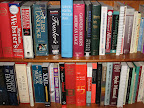
A small section of my reference library.

Dictionary

Dictionaries go beyond telling you how to spell word correctly and what a word means. They also give you word history, syllabication (a fifty-cent word for how it breaks into syllables), labels (offensive, slang, obsolete), and more. Here are some popular dictionaries:
  • Merriam-Webster Unabridged: A good unabridged dictionary will list far more words than a collegiate dictionary will. MW's dictionaries tend to be more conservative, meaning its lexicographers want more evidence of a word's stability before they add it to their dictionaries. You can subscribe to MWU online for a modest fee.
  • American Heritage Dictionary: By far my favorite dictionary. AHD tends to add newer words at a quicker rate and it offers excellent usage notes. The notes tend to be descriptive, meaning they describe the issue and differing opinions but don't dictate a solution. You can look up entries in AHD for free on Yahoo, get the dictionary on CD (beware: I had to give up my CD version when I switched to the 64-bit version of Vista; though I give Houghton Mifflin credit: when I reported to them I could no longer use the CD, they sent me an updated version for free. It will work for the 32-bit version of Vista, just not my less-popular 64-bit), or buy the paper version.
  • Webster's New World College Dictionary: The Associated Press's official dictionary. If you strictly follow AP style, this is the dictionary for you.
  • Word Spy and World Wide Words: These sites are good for very new terms. The men behind the scenes are serious about words and go to great lengths to define them.


Also check out industry-specific dictionaries and glossaries. Online, look for ones that have been edited by professionals. Webopedia is good for Internet-related terms. There's an editorial staff behind it that ensures definitions are accurate. (Disclosure: I used to work for Webopedia's parent corporation, though I never worked with the Webopedia folks.)

Thesaurus

Sometimes you just need a synonym -- or an antonym. A good thesaurus can help you out. Here are three I use:
  • Thesaurus.com: A free resource.
  • Visual Thesaurus: A neat concept, where you can see the relationship between words as distance. You can subscribe online or purchase the CD. (Again, my CD wouldn't work with my 64-bit Vista.)
  • Roget's International Thesaurus: The granddaddy of thesauri (or thesauruses, if you prefer Anglicized plurals). This is the one your English teacher probably taught you to use. She was right: the current version has more than 330,000 words and phrases.
  • The Gregg Reference Manual: The is a great reference for business style and offers a healthy section on grammar.

Style Guide

A style is meant to provide some consistency among a publisher's content. It should be invisible rather than distracting. Which style guide you follow depends on what you're writing about and who you are writing for.

Usage/Grammar Guide

You'll need at least one good guide on usage and/or grammar for when you run into sticky situations. Some are written in easy-to-understand English, others take a more comprehensive approach. Choose one that fits your style:

Writing Advice

What are your favorite resources? What else do you, as a writer, need? Let me know in the comments below!

(And, yes, I earn a few pennies if you use click on an Amazon link and buy a book. Support your local editor and click!)

Monday, October 5, 2009

Weekly Vocab Builder

Missed some of last week's vocabulary via Twitter? Here's the roundup. Use one or more in a sentence in the comments section!

Web scraping: http://bit.ly/3Z9Imu.
Gallivant: http://bit.ly/tzXm3.
Susurrus: http://bit.ly/3iFLG.
Phantasmagorical: http://bit.ly/KMdWn.
Endgame: http://bit.ly/Rw7Cd.

Be sure to check out more words on Wordie and follow me on Twitter to get the word of the day.

Friday, October 2, 2009

It's a Shame to Waste a Good Recession

Today is my last day with ClickZ, a site I've worked for for nine years. I joined just before the dot-bomb and have weathered the ups and downs. I still like what ClickZ has to offer; its writers are the best and the information is top shelf. Really, if you want to be a better digital marketer, you need to read this site daily. Trouble is, I want to do more. I want to share what I've learned about marketing and writing with others. So I'm taking the plunge: quitting my day job and putting my efforts into my fledgling editing business.

But is this really the time to be quitting my job and putting more time into a small venture?

In a word, yes.

"This is the best time to start," says zenhabits. "This is a time when job security is low, so risks are actually lower. This is a time to be lean, which is the best idea for starting a business. This is the time when others are quitting -- so you’ll have more room to succeed."

I read today's title in an article that encouraged entrepreneurial ventures, and thought: "Yes!" (I actually thought, "Can I really do this? Is this my 'walk on the moon?" I had been toying with the idea and had been listing to a lot of Great Big Sea, but I digress.)

This certainly is a "good" recession. Budgets are still being cut, and those without jobs are having a hard time finding new ones. And I do hate waste. So I'm jumping in with both feet. I'll be working my editorial freelance business, Right Touch Editing, full time. I'll be offer all levels of editing, plus editorial training for your staff, on site or online, to lessen your need for editorial help in the long term.

Here, I'll offer you writing and editing advice to help you improve your copy and get the results from it you desire. You've already seen some of it: vocabulary builders, quick tips, quizzes, and resources. I can even help you find vendors in other publishing areas, such as designers and publishers.

So stick around. Add this blog to your RSS feed or follow me on Twitter so you don't miss a single post. Now's the best time to improve your own skills, and I can help you do that. It'd be a shame to waste a good recession.

Tuesday, September 29, 2009

Weekly Vocab Builder

Improve your lexicon with these words. Use one or more in a sentence in the comments section!

MFA: Made for AdSense. A derogatory term for sites created just to post ads through Google's AdSense program and get readers to click on the ads.

Canonicalization: The process of converting computer data with more than one way to format it into a standard (canonical) format.

Wlatsome: Disgusting; foul.

Interrobang: ‽ A punctuation mark that combines a question mark and an exclamation, usually used to convey surprised questioning.

Stabby: Making a stabbing action. Able to make a stabbing action.

Be sure to check out more words on Wordie and follow me on Twitter to get the word of the day.

Monday, September 28, 2009

Grammar Quiz...Answers!

On Friday, I offered you a couple quick quizzes to test your grammar knowledge. As promised here are the answers.

Subject/Verb Agreement. Choose the correct verb.
1. Either you or Vern wins this silver pin.
2. The herd of cattle was sold for a large sum.
3. Hundreds of daffodils are blooming on that hill.
4. Not one of the cows is purple.
5. Relief for the sufferers was in sight.

Related Verbs. Choose the correct verb.
1. Who taught you how to swim?
2. After I had learned these things, he taught me some more advanced strokes.
3. Let us not make our decisions hastily.
4. After I have told you what I know about Tom, I will leave the decision to your good judgment.
5. May I see your tickets? Yes, you may.
6. Can you speak French? No, I can not.
7. Did you accept the nomination?
8. Marion invited all the girls in our class. She excepted nobody.
9. Does George think he will be excepted from the general rules?
10. The muskrat accepted the morsel daintily.

Adjective or Adverb. Choose the correct word.
1. Our tenant pays his bills slowly.
2. She stepped along quickly and spryly.
3. Ellen felt badly about breaking the vase.
4. The country looks beautiful today.
5. We think differently about that.

How did you do? E-mail me or post below any questions or comments you have.

A glutten for more? Check out these sites:

Friday, September 25, 2009

Grammar Quiz: Grammar Basics

It's Friday, and my third grader is taking a battery of quizzes to show he learned something this week. Maybe that's not a bad idea for us adults. Herewith, three quizzes on basic grammar knowledge. All exercises are from Easy English Exercises by Ada Riddlesbarger and Nell Stillwagon (World Book Co., 1956). Good luck!

Subject/Verb Agreement. Choose the correct verb.
1. Either you or Vern (wins, win) this silver pin.
2. The herd of cattle (was, were) sold for a large sum.
3. Hundreds of daffodils (is, are) blooming on that hill.
4. Not one of the cows (is, are) purple.
5. Relief for the sufferers (was, were) in sight.

Related Verbs. Choose the correct verb.
1. Who (learned, taught) you how to swim?
2. After I had (learned, taught) these things, he (learned, taught) me some more advanced strokes.
3. (Let, Leave) us not make our decisions hastily.
4. After I have told you what I know about Tom, I will (let, leave) the decision to your good judgment.
5. (Can, May) I see your tickets? Yes, you (can, may).
6. (Can, May) you speak French? No, I (can not, may not).
7. Did you (accept, except) the nomination?
8. Marion invited all the girls in our class. She (accepted, excepted) nobody.
9. Does George think he will be (accepted, excepted) from the general rules?
10. The muskrat (accepted, excepted) the morsel daintily.

Adjective or Adverb. Choose the correct word.
1. Our tenant pays his bills (slow, slowly).
2. She stepped along (quick, quickly) and (spry, spryly).
3. Ellen felt (bad, badly) about breaking the vase.
4. The country looks (beautiful, beautifully) today.
5. We think (different, differently) about that.

I'll post the answers on Monday.

Update: View the answers here.

Monday, September 21, 2009

Weekly Vocab Builder

Part of writing well is having a rich vocabulary...and knowing how to use it. Check out these words from my Twitter Vocab Builder feature.
NIMBY: http://bit.ly/nv5NP
Cap and trade: http://bit.ly/1VBZT
Carrefour: http://bit.ly/15hycT
Gadabout: http://bit.ly/HTUrx
Abecedarian: http://bit.ly/DtWHO
Increase your vocabulary even more. Get the Word of the Day from Dictionary.com; it's available via RSS feed, e-mail, Facebook, and lots more!

I've lots more words at Wordie than I can share here. Check them out! Plus you can follow me on Twitter (@ebrenner) to get the vocab word of the day.

Update: Wordie is now part of Wordnik, but my growing lists of words are still available to all. You can also check out another growing list of terms of mine at City Dictionary.

Friday, September 18, 2009

Writing Tip: What's That You Say?

The Hartford Courant recently began aggregating content from other media outlets. Unfortunately, it wasn't always attributing the content and has apologized. Whether intentional or not, presenting someone else's words as your own, in small part or in their entirety, is called plagiarism, and it's a big no-no.

Now, I don't think you, dear readers, are going to pick up someone else's copy, slap your name on it, and present it for all the world to see. If you were, you wouldn't be wasting your time reading a blog to help improve your writing.

Yet quotations can be invaluable to your copy. They can offer authority to what you're saying, colorful commentary, or more information. You must deal with quotes correctly to avoid be called a plagiarist. Today, a brief rundown of handling quotes.

The most important thing to remember is this: if you quote someone, you must identify the quote and who said it. Quotation marks are the most common way to set off a quote, but you can also introduce the quote and then indent the quote itself (as I do later with the Bill Walsh quote).

If the quote is from a written piece, what's the title of the piece and when was it written? If you quote a Web site, what's the URL? Even if you don't publish all this additional information, having it ensures you can back up your claims should anyone question their accuracy.

Can you edit direct quotes? In a word, no. Most authorities, including AP and Chicago, dictate that direct quotations not be altered. Easy enough when you're quoting the written word: just copy and paste. But what about the spoken comment?

Again, don't alter the quote. If there's a question about what the person said, ask him or her to clarify. Even if this means following up later, when you realize something's not clear. Better to check before you publish than fix it after -- if you can.

Bill Walsh, copy chief of the national desk at The Washington Post, summarizes dealing with spoken quotes in Lapsing Into a Comma:
This doesn't mean we need to reproduce every um, every er, every cough; it doesn't mean a reporter's transcription errors can't be corrected; and it certainly doesn't mean that stories should attempt to re-create dialect (plenty of literate people pronounce should have as "should of"). But it does mean that a reader should be able to watch a TV interview and read the same interview in the newspaper and not notice discrepancies in word choice.
Finally, use quotes judiciously. That's your name on the piece. Readers are expecting your words, your wisdom. Don't quote so much that someone else is writing your copy.

If you want more information on quotes, check out The Associated Press Stylebook 2009, The Chicago Manual of Style, or Garner's Modern American Usage. There are all kinds of style manuals out there, of course, but these are the ones I use most frequently. And if you're ever in doubt about how to handle a situation, just ask. That's what your editor is for!

Monday, September 14, 2009

Writing Tip: Unpack Your Suitcase

Portmanteau, or suitcase, sentences are long sentences packed with lots of information. They're called that, says James Kilkpatrick in his now-defunct Charlotte Observer column, "The Writer's Art," "for the 16th-century suitcase. It was huge. You could pack everything into a portmanteau. Without pausing for a burp, it could swallow 10 suits, six robes, four pairs of shoes, a month's worth of underwear and three fifths of Scotch."

There's nothing wrong with suitcase sentences per se, as long as they're grammatically sound. Take a look at this sentence:
Seems the pressure that has been placed on advertising and marketing teams in our industry is that e-mail communications (which, based on every metric I have seen, continues to generate some of the most impressive and trackable return on investment) has been designated as the budget whipping boy.
The sentence isn't ungrammatical. But readers are looking to quickly digest your wisdom. They want you to get to the point quickly. Though they're understandable, suitcase sentences take more time to comprehend. They slow readers down. You risk your readers getting frustrated and tuning out.

Yet there's no need to dumb-down content. Readers aren't unintelligent, just busy. Your best bet is to split the suitcase sentence into two or more sentences. Let's unpack that sentence above:
Based on every metric I've seen, e-mail continues to generate some of the most impressive and trackable ROI. Yet advertising and marketing teams are pressured to make e-mail communications the budget whipping boy.
We've regrouped the ideas a bit, trying to preserve the same punch of the whipping boy at the end. We've introduced the idea with how valuable e-mail is; it generates impressive ROI. We've then put the idea of ad and marketing teams being pressured closer to the rest of the thought (e-mail comm being a whipping boy) We've ended it with the punch: that despite being valuable, e-mail comm is a whipping boy.

Next time you notice a suitcase lurking in your writing, stop to consider whether it should be unpacked.

Need more help unpacking your suitcase and other writing challenges? E-mail me or post a comment below!

Friday, September 11, 2009

Weekly Vocab Builder

Can you define all these words? Follow the links to build your vocabulary!

Cyberculture: http://bit.ly/2M9mo4
Geolocation: http://bit.ly/RTBT2
Nor'easter: http://bit.ly/121r1I
Ratchet: http://bit.ly/195Uab

Thursday, September 10, 2009

Grammar Bite: Active vs. Passive Voice

You want to keep your readers engaged with your writing to the end. You want them awake and interested in what you have to say. One way to do this is to use more active voice and less passive voice in your writing.

Active voice? Passive voice? What is all this grammar mumbo-jumbo? Simply put:
Voice refers to the form of the verb. The subject acts when you use the active voice verb form. In passive voice, the person or thing performing the action becomes the object of the sentence. It does not act; it is acted on by the verb. (When Words Collide, 86)
For example:
Passive: An increase will occur in behavioral targeting opportunities.
Active: Behavioral targeting opportunities will increase.
There's nothing wrong with the first sentence. It's grammatically correct, and it gets the point across. The second sentence, however, works a little better. The reader gets the point quicker, making it easier to understand. In the first sentence, we first discover that increases will occur. Where will they occur? The answer comes at the end of the sentence: in behavioral targeting opportunities. In the second sentence, we don't have to ask what will increase. We know right away it's behavioral targeting opportunities.

Passive voice emphasizes the receiver of the action, because that's more important, the actor is unknown, or you don't want to mention the actor: "Because online technology is shifting so quickly, the guidelines must be updated frequently."

Too much passive voice, however, can slow down the reading process. In today's world, that could mean the reader never finishes reading your piece.

The active voice is quicker and easier to read. It's direct, to the point: exactly what most readers want. It doesn't hide the sentence's subject, which helps build readers' trust in what you say.
Passive: In 2008, it will be imperative that the industry's research and measurement leaders step up and deliver ways to better track the success of every dollar advertisers spend.

Active: In 2008, the industry's research and measurement leaders must deliver ways to better track the success of every dollar advertisers spend.
Garner's Modern American Usage offers this advice for finding passive voice: Look for a be-verb (or get) plus a past participle (usually a verb ending in -ed). For example: is discussed, were delivered, been served, being flattered, and get stolen.

Also, says Garner, watch for the be-verb or get to be implied: "Recently I heard it suggested by a friend that too many books appear with endnotes." "Being" is implied after it in this sentence, making it passive. The active version: "Recently I heard a friend suggest that too many books appear with endnotes." You get the idea right away that your friend suggested something.

Resources:

E-mail me or post a comment below if you have questions!

Tuesday, September 8, 2009

Writing Tip: Avoiding the I-I-I

Writers are often encouraged to "speak from the I," sharing their experiences with readers and imparting valuable advice in the process. The trick, of course, is to keep that first-person point of view while focusing more on the readers rather than yourself.

One way to achieve this balance is to limit the use of I in your text. Copy that starts with I and heavily uses it throughout can be a turnoff for readers. They want your knowledge and experience, but they want you to be concerned mostly with them. (Rather like advertising, isn't it?)

Try this: in your draft, highlight every use of the word I in red. Is your copy bleeding? You might be using I too much. Try recasting some of those sentences, eliminating the I:
Orig.: "In part two, I'll cover the Google-Yahoo deal in more detail."
Recast: "Part two will cover the Google-Yahoo deal in more detail."
Recast: In part two, we'll look at the Google-Yahoo deal in more detail."

Orig.: "When I meet anyone for the first time, I suggest using Google to learn more about me and to see what other people have said about me."
Recast: "When you meet anyone for the first time, suggest using Google to learn more about you and to see what other people have said about you."

Check out these articles for more ideas on recasting your sentences:

Friday, September 4, 2009

Vocab Builder

Can you define all these words? Follow the links to build your vocabulary!

Hyacinth Bucket Syndrome: http://bit.ly/1eOMwE
Lion of the Senate: http://bit.ly/ntj2g
tintinnabulation: http://bit.ly/U8RbT
gallicism: http://bit.ly/DkzNG
lackadaisical: http://bit.ly/3TU1kE
redolent: http://bit.ly/vskqp

Tuesday, September 1, 2009

Grammar Bite: Correlative Conjunctions

Correlative conjunction is the grammarian's fancy term for a pair of conjunctions that join two matching sentence parts, such as not only...but also and both...and. The trick with these conjunctions is the sentence parts they join must be structured the same way. For example:
Not only was I sick, but I was also tired.
He not only will call but also will send flowers.
Both she and I have completed the coursework.
The book is both long and complicated.
In the first example, both parts of the sentence have a subject-verb structure (technically, these are two complete sentences). In the second example, the conjunctions are joining two verb phrases: will call and will send flowers. If you're going to use not only, be sure to follow it with but also (or but...as well or but...too).

In the third example, both...and are joining she and I, subject pronouns for the verb have completed. In the last example, the conjunctions are joining two adjectives describing book: long and complicated. In these cases, you could choose to drop both:
She and I have completed the coursework.
The book is long and complicated.
But if you use both to join two parts, you'll need to follow it with and:
Wrong: The book is both long or complicated.
Right: The book is both long and complicated.
Some other correlative conjunctions to watch for:
  • Although...nevertheless
  • Although...yet
  • As...as
  • Either...or
  • If...then (though then can often be dropped to streamline the sentence)
  • Just as...so also
  • Neither...nor
  • Since...therefore
  • When...then (then can sometimes be dropped to streamline)
  • Whether...or
Think you've got it? Try this quiz. You'll get your score after completing the quiz and continue taking it until you get all the questions right. E-mail me or post a comment below if you have questions!